Why Great Partner Programs Don't Happen by Accident
Great partner programs look effortless from the outside. They're not. Every one of them was built on trust, on preparation, on activation that actually happened. This is the series that runs through the site: six parts, each one pulling together a real run of episodes. 3 of 6 parts are live now on the Weekly Wave.
Foundation
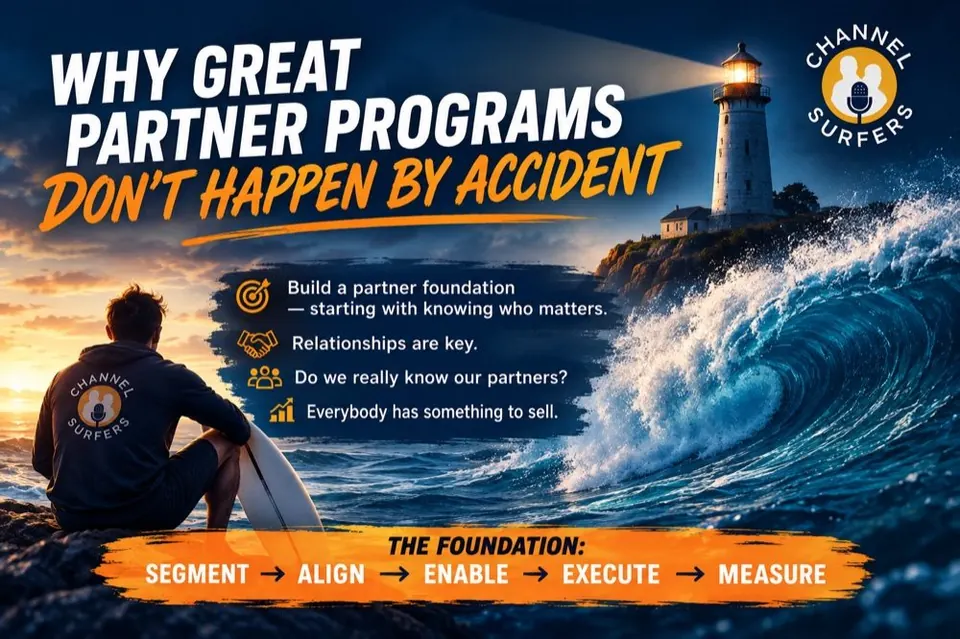
Great partner programs are not built on activity. They are built on intentional execution.
Most partner programs don't fail from a lack of activity. Partners get recruited, tiered, trained, invited to meetings. That looks like progress. They fail because the foundation was never clear enough to support real execution: is the partner a good fit, is the value exchange real, are internal teams aligned, does anyone agree on how success gets measured? Part 1 lays out the framework (Segment, Align, Enable, Execute, Measure) that has to be true before anything downstream holds.
Revenue Operating System
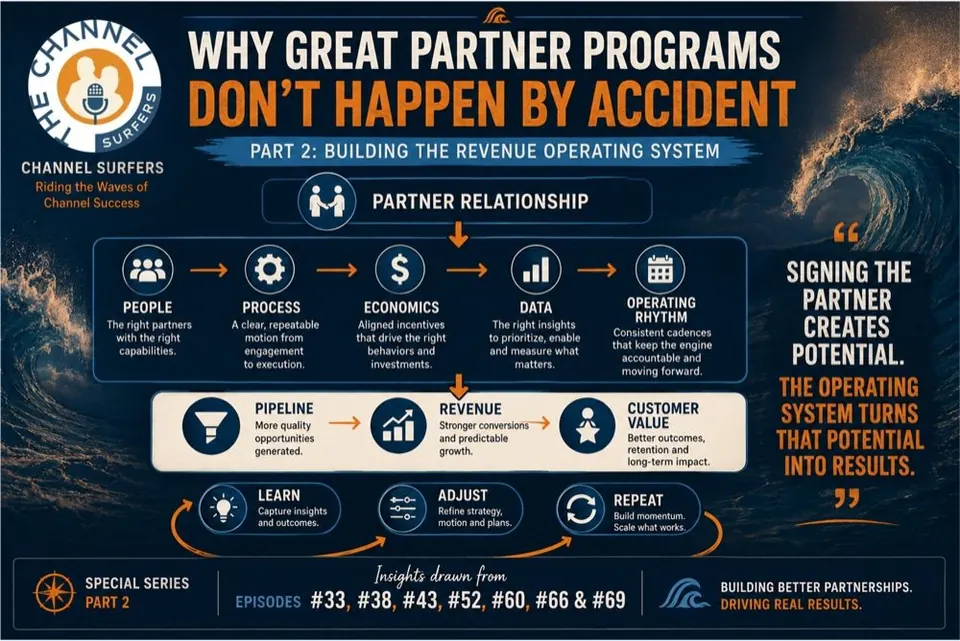
The missing piece is not another partner. It is the execution layer between the relationship and the revenue.
A signed partner creates potential. It doesn't create revenue by itself. Part 2 is about the execution layer that connects partner strategy and infrastructure to actual pipeline: People, Process, Economics, Data, and Operating Rhythm, running on a continuous loop (Plan, Enable, Execute, Measure, Optimize). Weak on any one piece and the motion gets inconsistent. Working together, the organization can learn, adjust, and repeat what works.
Activation
Signing the partner creates potential. Activation gives people a reason and a way to move.
A signed partner is only the beginning. Onboarding is a checklist. Activation is when the partner starts actually selling, referring, and building internal mindshare. Eight guests, four connected conversations, one progression: Signed → Enabled → Engaged → Active → Producing.
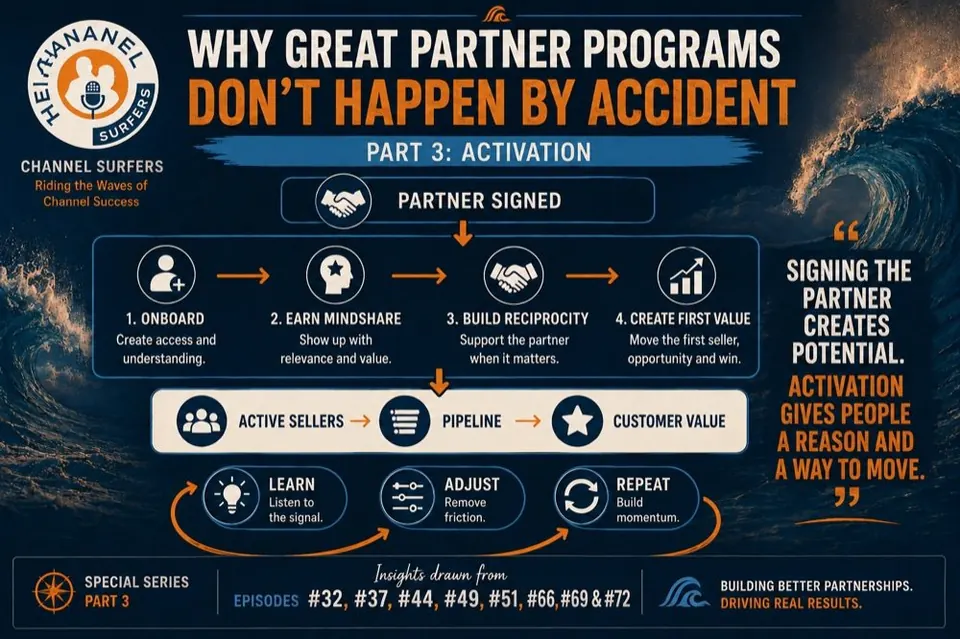
See the Ep 44 activation infographic → Read this part on the Weekly Wave →
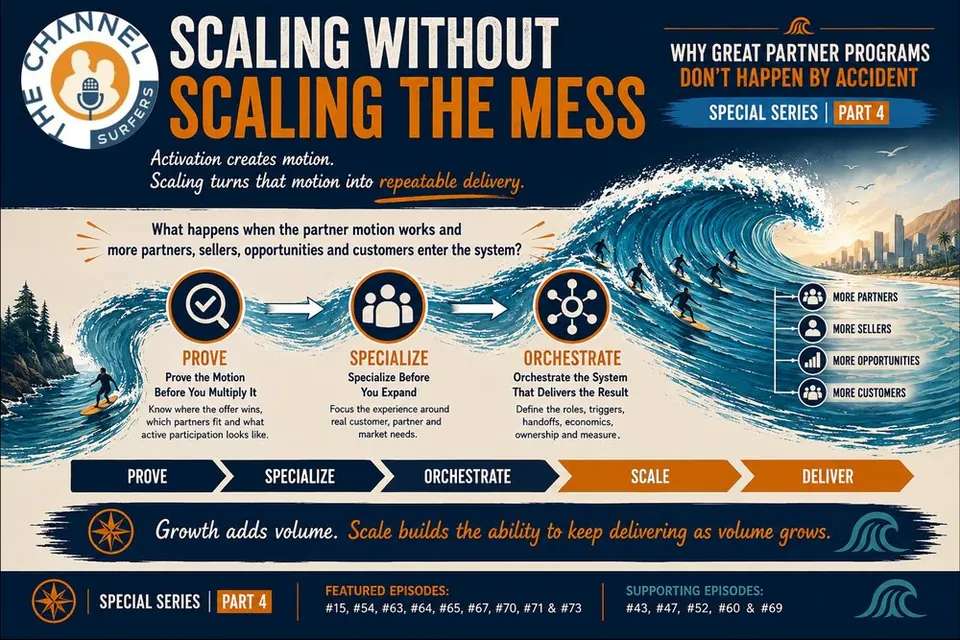
Scaling Without Scaling the Mess
More partners can't fix a motion the business hasn't proven yet.
Activation creates motion, and scaling turns it into repeatable delivery. The path has five steps: Prove, Specialize, Orchestrate, Scale, and Deliver. Prove the motion before you multiply it. Focus the experience on real customer, partner, and market needs. Then define the roles, triggers, handoffs, and measures that keep delivery consistent as volume grows.
Evolution
How the channel is actually changing: ecosystems, AI, marketplaces, nearbound, and the MSP/MSSP shift, without the buzzword version of any of it.
The Feedback Loop
The patterns that showed up again and again, the big lessons, and what channel leaders should actually do next: not a final word, but a starting point. The channel keeps moving, so this part closes the loop back to Part 1 and sets up the next run.